
You open three loan estimates side by side. Same home. Same loan amount. Same term. But the numbers don’t match up. One gives you a lower rate but comes with fees that make you hesitate. Another asks for less upfront but leads to a higher monthly payment. Then there’s the one with fee names that are practically written in another language.
If you’ve ever wondered how you’re supposed to choose between estimates that feel this different, you’re in good company. Mortgage shopping can feel confusing, especially when everyone keeps insisting the rate should make the decision for you.
But here’s the truth: When it comes to mortgages, the rate is only part of the story.
Mortgage Rates and Fees at a Glance
- Your interest rate represents the cost of borrowing money (shown in a percentage). It affects your monthly payment and the total interest you pay throughout your loan.
- Your fees are additional costs that you typically pay at closing. They don’t affect your monthly payment or interest.
- Lower rates often come with higher fees. If you want a lower rate, you may be able to negotiate that by paying more fees at closing.
- You may have to pay Private Mortgage Insurance (PMI) depending on how much you put down. This isn’t exactly a rate or a fee, but it’s an important cost to watch for.
- Both rates and fees matter, and your strategy depends on how much you want to pay now versus later. Talk to a Mortgage Loan Officer to decide what’s best for you.
Mortgage Interest Rates vs. Fees
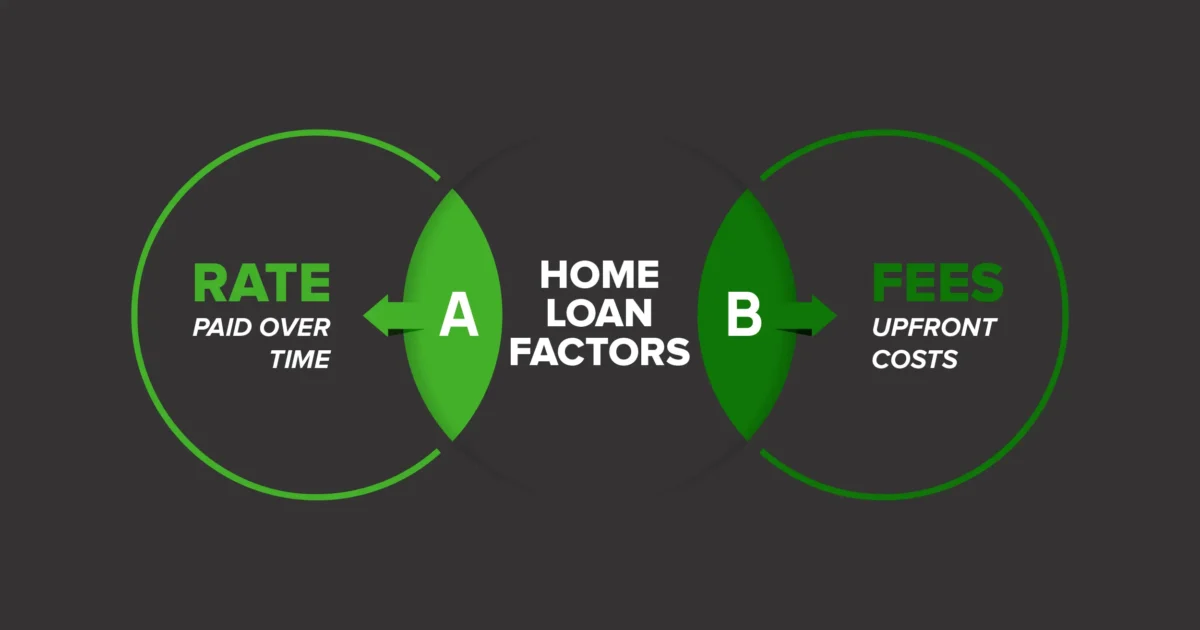
Most mortgage comparisons come down to two things: the interest rate and the fees attached to the loan. They’re usually talked about in the same breath but can affect your costs in completely different ways. Understanding how they work can help you see the big picture.
The Interest Rate: What You Pay Over Time
Your interest rate is the cost of borrowing money, shown as a percentage. It influences your monthly mortgage payment and the total interest you’ll pay throughout the loan.
Because most mortgages last for decades, the interest rate usually gets the most attention. A lower rate tends to mean lower monthly payments and less interest paid over time. It’s easy to see why people focus on it, but the interest rate isn’t the whole story.
Fees: What You Pay Up Front
Mortgage fees are typically paid at closing and don’t show up in your monthly payment. These can include:
- Lender fees, like origination, underwriting, or processing
- Third‑party fees, like appraisal, title, escrow, or credit report costs
- Optional fees, like discount points used to lower the interest rate
Some fees come directly from the lender, while others are tied to outside services that are part of every mortgage. Either way, they determine how much cash you need on closing day.
That’s where many borrowers are caught off guard. Two loans with similar monthly payments can require very different amounts of money up front, and that difference often comes down to how fees are structured.
To compare mortgage options, look at how the rate and fees work together. That’ll tell you why a loan that looks cheaper at first glance may or may not be the better fit for your situation.
Why a Lower Rate Can Come With Higher Fees
At some point in your mortgage search, you may notice something that feels backward: the loan with the lowest interest rate tends to also have the highest upfront costs. This isn’t a trick, and it isn’t a mistake. It’s a tradeoff.
Lenders can structure loans in different ways depending on when you want to pay more of the cost: over time, or up front. One of the most common ways this shows up is through something called discount points.
What Are Discount Points?
Discount points are optional fees you can pay at closing to lower your interest rate. Each point typically costs a percentage of the loan amount and reduces the rate by a small amount, though the cost and rate reduction associated with discount points vary based on market conditions and lender pricing.
In simple terms, you’re paying more now in exchange for a lower monthly payment later.
This is why two loans can look so different on paper. One may advertise a lower rate but require higher fees at closing, while another may offer a slightly higher rate with fewer upfront costs. Neither option is inherently better; it just depends on your goals.
| Loan Option A | Loan Option B | |
| Interest Rate | Slightly higher | Slightly lower |
| Monthly Payment | Higher | Lower |
| Upfront Fees | Lower | Higher |
| Cash Needed at Closing | Less | More |
When Paying More Over Time Can Make Sense
Choosing a loan that costs more over time (like Loan Option A) can be a good option if:
- You expect to move in a few years
- You plan to refinance
- You’d rather keep more cash available now
In those cases, a slightly higher rate with lower fees could actually cost less overall.
When Paying More Up Front Can Make Sense
On the other hand, a lower rate with higher fees (like Loan Option B) may be a good fit if:
- You plan to stay in the home long term
- You want the lowest possible monthly payment
- You’re comfortable bringing more cash to closing
Over time, the monthly savings can outweigh the upfront cost.
The key takeaway is this: a lower rate doesn’t automatically mean a lower total cost. It just shifts how and when you pay.
The Break‑Even Question
One helpful way to compare loans is to ask about the break‑even point—the moment when the money you saved each month finally equals the extra fees you paid upfront.
Let’s pretend that:
- Loan B costs $3,000 more upfront
- It saves you $75 per month
$3,000 ÷ $75 = 40 months
If you’ll be in the home longer than that, Loan B may make sense. If not, Loan A could be the smarter choice. There’s no “right” answer, just the one that fits your plans.
Private Mortgage Insurance (PMI): Another Cost to Watch For
As you’re comparing loan estimates, you may notice something else that affects your monthly payment: private mortgage insurance, often called PMI.
With PMI, you may be able to get a home without waiting years to save a large amount of cash for a down payment. That’s because lenders use down payments, typically about 20% on conventional loans, to offset the risk of loaning you the cost of the home. If you can’t supply a large down payment, lenders ask you to pay PMI so they can stay protected in case the home goes into foreclosure.
Most home loans require some form of mortgage insurance unless certain down payment thresholds are met, and those vary by loan type. The way it’s charged can also vary. In some cases it’s a monthly cost, and in others there may be an upfront component, a monthly component, or a combination of both.
While PMI does increase your monthly payment, it isn’t automatically a bad thing. For many borrowers, it’s what makes buying a home possible sooner rather than later. It also usually isn’t permanent. As your loan balance decreases and your home value increases, it can often be reduced or removed altogether, depending on the loan type.
PMI Example
This is where the break‑even idea we discussed earlier comes back into play. Imagine PMI costs $90 per month, or about $1,080 per year. Now compare that to waiting an extra year to save more money for a down payment. If home prices increase 4% in that same year on a $300,000 home, that’s a $12,000 increase in price. Even if PMI could have been avoided by waiting, it would take more than a decade of PMI payments to break even with that one year of price growth.
You might pay a little more each month in exchange for buying earlier, before prices rise, and while your housing payment is building equity instead of paying rent.
Ultimately, PMI isn’t good or bad on its own. It’s another variable in the comparison, right alongside interest rates, fees, and how long you expect to stay in the home.
Why Fee Names Can Look Different from Estimate to Estimate
During the mortgage process, many homebuyers wonder, “Why does the same fee seem to change names depending on the lender?”
Short answer: Labels vary, but costs matter more than wording. One lender might list “Origination Fee,” but another might split that into a “Processing Fee” and “Underwriting Fee.” When you’re reviewing a loan estimate, focus on the total cost, not categories.
Seeing Mortgage Rates and Fees as a Whole
At the end of the day, there isn’t a clear winner between lower mortgage rates and fees. Mortgage shopping is more about finding a structure that fits your budget today and supports your plans tomorrow. The lowest number on the page can only tell you so much.
Rates matter. Fees matter. But understanding how they work together matters most.
And just like every other step in the homebuying journey, you don’t have to figure it out alone. Reach out to a Mortgage Loan Officer to kick off the home-buying process and get answers to your rates vs. fees questions and more.
Equal Housing Lender.