Choosing where to keep your money isn’t a decision most people think about every day. Often, people open an account when they get their first job, head off to college, or move to a new city and simply stick with that institution for years.
Credit Unions vs. Banks at a Glance
- Neither option is automatically better. The right choice depends on your financial needs, preferences, and goals.
- Modern credit unions frequently offer the same everyday banking services as banks such as online banking, mobile apps, loans, credit cards, mortgages, and digital payment options.
- Safety shouldn’t be a deciding factor between the two since eligible deposits at federally insured credit unions and banks both receive federal deposit insurance protection.
- Membership is often easier than people expect. Many credit unions allow membership through where you live, work, attend school, worship, or qualifying family relationships.
- Compare the complete experience before deciding. Service, digital banking, ATM access, rates, fees, financial education resources, and convenience may all influence which institution feels like the better fit.
But eventually, many people begin asking questions such as:
- Am I paying unnecessary fees?
- Could I get a better loan rate somewhere else?
- Is there a more personal alternative to a large bank?
- Would a credit union better fit my needs?
If you’ve ever wondered whether a bank or a credit union is the better choice, you’re not alone. It’s one of the most common questions consumers ask when evaluating financial institutions.
The good news is that both banks and credit unions can help you manage your money, save for future goals, and access loans when needed. The key is understanding how they differ and which option aligns best with your priorities.
The Biggest Difference Is Ownership
The most important distinction between a bank and a credit union isn’t the checking account, mobile app, or ATM network. It’s ownership.
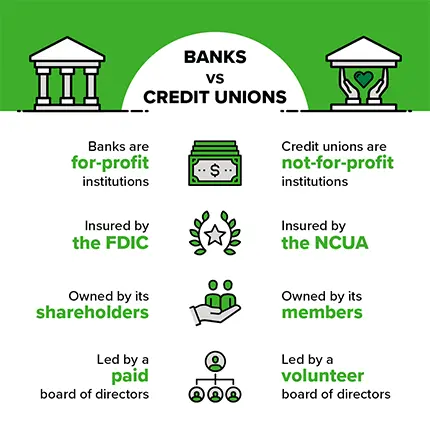
Banks are typically owned by shareholders and operate as for-profit businesses. Their goal is to generate returns for investors.
Credit unions operate differently. They are member-owned financial cooperatives. When you join a credit union, you become a member-owner rather than simply a customer. Instead of serving outside shareholders, credit unions exist to serve their members and communities. This member-focused structure is one reason many people are attracted to the credit union model.
Potential Advantages and Limitations of Each
Both banks and credit unions can be excellent financial partners. The better choice depends less on the institution type and more on how well it aligns with your financial needs, service expectations, and long-term goals.
Credit unions appeal to many consumers because they operate as member-owned cooperatives rather than shareholder-owned companies. This structure often allows them to focus on member value through competitive rates, lower fees, financial education resources, and personalized service. Many people also appreciate a credit union’s community involvement and member-focused approach. On the other hand, credit unions may have membership requirements and, depending on the institution, may have fewer local branches than a large national bank.
Banks may be a good fit for people who prioritize broad geographic access, specialized banking services, or an established national presence. Some large banks maintain extensive branch and ATM networks, which can be particularly valuable for frequent travelers or people who regularly relocate. Certain banks may also offer specialized products or international banking services that aren’t available everywhere. However, fees, rates, and service experiences can vary significantly from one bank to another, just as they can among credit unions.
When comparing institutions, it’s helpful to remember that neither option is universally better. Many modern credit unions offer the same everyday services consumers expect from banks, including checking and savings accounts, mortgages, auto loans, credit cards, digital banking, mobile apps, bill pay, and account-management tools. The most useful comparison is often not “credit union versus bank,” but “which institution best supports the way I manage my money?”
Are Credit Unions as Safe as Banks?
One of the most common concerns people have about credit unions is safety.
The short answer is yes.
Deposits at federally insured credit unions are protected by the National Credit Union Administration (NCUA), while deposits at participating banks are protected by the Federal Deposit Insurance Corporation (FDIC). Both systems provide federal deposit insurance for eligible accounts and are designed to protect consumers’ money.
For most people, the practical takeaway is simple:
A federally insured credit union provides deposit protection similar to a federally insured bank.
Many consumers are surprised to learn that credit unions aren’t some lesser version of a bank. Federally insured credit unions participate in their own federal insurance system specifically designed to protect member deposits.
NCUA and FDIC: What’s the Difference?
While the names are different, the purpose is very similar.
The FDIC insures eligible deposits at participating banks. The NCUA insures eligible deposits at federally insured credit unions. Both exist to provide confidence in the financial system and help protect depositors if a financial institution fails.
From a consumer perspective, the more meaningful differences are often found in the institution itself rather than the insurance provider. Factors such as fees, rates, service philosophy, digital tools, and community involvement tend to have a much greater impact on everyday banking experiences.
What About Rates and Fees?
It’s impossible to make a blanket statement that every credit union has lower rates or every bank charges higher fees. Financial institutions vary significantly.
That said, credit unions often develop a reputation for competitive loan rates, lower fees, and more member-focused pricing because earnings are generally reinvested into the institution and returned to members through products, services, and pricing rather than distributed to shareholders.
Rather than assuming one institution is automatically better than another, compare the things that affect your wallet most:
- Monthly maintenance fees
- Savings rates
- Loan rates
- ATM fees
- Overdraft policies
- Account requirements
Can Credit Unions Offer the Same Services as Banks?
This may be the biggest misconception people have about credit unions.
Credit unions were historically associated with more limited membership requirements and smaller branch networks than many large national banks. Today, many credit unions offer a broad range of financial services, including checking and savings accounts, mortgages, auto loans, credit cards, online banking, mobile banking, and digital payment tools.
In fact, modern consumers frequently rank digital banking capabilities among their top priorities when evaluating a financial institution. Mobile apps, online account access, mobile deposit, card controls, and account alerts often matter just as much as branch locations.
For example, ICCU members have access to eBranch (online and mobile banking), CardControl, My Credit, financial education and wellness resources, and much more designed to help members manage multiple aspects of their financial lives in one place.
Can a Credit Union Replace Your Bank?
For many people, the answer is yes.
A credit union can often serve as a primary financial institution for everyday banking, savings, borrowing, digital banking, and long-term financial planning.
That doesn’t mean everyone needs to completely leave their bank. Some people maintain accounts at multiple institutions for convenience, specialized services, business banking, or investment purposes.
The better question isn’t whether a credit union can replace a bank.
The better question is:
Does this institution provide the services I actually need?
For many consumers, the answer is yes.
Who Can Join a Credit Union?
Another common concern is eligibility.
Many people assume credit unions are difficult to join or limited to specific groups. While membership requirements do exist, they are often much broader than consumers expect.
Eligibility is frequently tied to where you live, where you work, family relationships, or other qualifying affiliations. Depending on the credit union, membership can be available to large portions of a state or region.
Because eligibility varies from one credit union to another, it’s always worth checking the current requirements before assuming you don’t qualify. If you’d like to learn more, review ICCU’s membership eligibility requirements to see whether membership may be available to you.

What Should You Compare Before Deciding?
Consumers often focus exclusively on rates. Rates matter, but they aren’t the whole picture.
Think about how you interact with your money every day. Do you primarily use a mobile app? Do you value local branches? Do you want access to financial education tools? Are you likely to need a mortgage, auto loan, or retirement resources in the future?
Instead of focusing on one feature, compare the complete experience.
Convenience
- How often do you visit a branch?
- Do you need ATM access while traveling?
- Do local branches matter to you?
Digital Banking
- Can you deposit checks from your phone?
- Are account alerts available?
- Can you manage cards, transfers, and payments digitally?
Costs
- Monthly account fees
- ATM fees
- Overdraft policies
- Loan rates
- Savings rates
Service and Support
- How easy is it to reach someone when you need help?
- Are support options available online, by phone, by video, and in person?
Future Needs
- Are you planning to buy a home?
- Will you need a vehicle loan?
- Do you want retirement planning resources?
- Will you need business banking services?
Comparing these factors often provides a clearer picture than looking at rates alone.
What If You Decide to Switch?
Many people delay switching because they assume it will be complicated.
In reality, the process is often straightforward.
Most people start by opening a new account, enrolling in online banking, moving their direct deposit, updating recurring payments, transferring funds, and then closing their old account after everything has cleared. Many institutions also provide resources to help guide members through the transition.
The process typically takes more organization than effort.
So, Which Is Better?
There isn’t a universal answer.
A large national bank may be a great fit for someone who values a nationwide branch network or specialized banking services.
A credit union may be a great fit for someone who values member ownership, personalized service, competitive pricing, community involvement, and financial education.
Neither option is inherently right or wrong.
The best financial institution is the one that supports your goals, provides the services you need, and helps you feel confident managing your financial life. Whether you ultimately choose a credit union, a bank, or maintain relationships with multiple institutions, taking time to compare your options can help you make a more informed decision.
If you’re curious whether a credit union might fit your needs, explore current membership requirements, compare account options, and review the services available before making your choice.
ICCU offers products and services designed to support members through everyday banking, major life milestones, financial education, retirement planning, business banking, and more. Resources such as MoneyEdu and Retirement Simplified can also help members make informed financial decisions beyond simply opening an account.
The goal isn’t to choose a credit union because it’s a credit union. It’s to find the financial institution that best supports your financial success.
FAQ’S
What should I compare before choosing a financial institution?
Look beyond rates and fees. Consider mobile and online banking capabilities, ATM access, branch convenience, customer service, security tools, financial education resources, loan options, and overall ease of use.
If I move, can I keep my credit union membership?
In most cases, yes. Membership is often for life as long as your account remains in good standing, even if you later move or change jobs. Specific policies can vary by institution.
Do credit unions have good mobile banking?
Many do. Consumers increasingly evaluate financial institutions based on mobile apps, online banking, mobile deposits, transfers, alerts, and digital account management tools. Today’s credit unions often provide many of the same digital banking capabilities people expect from larger banks.
Do I need perfect credit to join a credit union?
No. Joining a credit union and qualifying for a specific loan are two different things. Membership eligibility is generally based on the credit union’s field of membership requirements rather than maintaining perfect credit. Loan qualification requirements vary depending on the product.
How do I know whether a bank or credit union is right for me?
Start by evaluating your priorities. Think about how you use your accounts, which services matter most, whether you prefer local or national access, what digital tools you rely on, and what financial goals you’re working toward. Comparing those needs against the institution’s offerings is usually more helpful than focusing solely on whether it’s a bank or a credit union.