
If you’re considering switching from a bank to a credit union, one question often comes up early in the decision-making process:
“Is my money still protected?”
It’s a fair question. For many people, a bank account is where paychecks are deposited, bills are paid, and emergency savings are stored. Before changing financial institutions, it’s important to understand what protections exist if something unexpected happens.
The short answer is reassuring: credit unions and banks both provide federal deposit insurance. The difference lies in who provides that insurance and how the institutions are structured. Understanding those distinctions can help you make an informed decision about where you keep your money.
Is Your Money Safe at a Glance
- Credit unions and banks can both provide federal deposit insurance. Eligible deposits at federally insured credit unions are protected by the NCUA, while eligible deposits at participating banks are protected by the FDIC.
- The biggest difference between a bank and a credit union is ownership. Credit unions are member-owned financial cooperatives, while banks are typically owned by shareholders.
- Rates and fees can vary from one institution to another. It’s worth comparing account costs, loan rates, savings rates, and other factors instead of assuming one option is always better.
- Most people don’t notice much difference between NCUA and FDIC insurance in everyday banking. Both exist to help protect eligible deposits and maintain confidence in the financial system.
- Choosing between a bank and a credit union is about more than deposit insurance. Convenience, technology, service, financial education resources, and long-term fit all play a role in the decision.
The Good News: Federally Insured Deposits Are Protected
Many people assume banks are safer than credit unions because they are more familiar with banks or recognize national banking brands.
In reality, federally insured credit unions and federally insured banks offer similar protection for deposit accounts.
At a bank, eligible deposits are protected by the Federal Deposit Insurance Corporation (FDIC).
At a federally insured credit union, eligible deposits are protected by the National Credit Union Administration (NCUA) through the National Credit Union Share Insurance Fund (NCUSIF).
Both forms of insurance protect eligible deposits up to applicable coverage limits established by federal law.
For the average consumer, that means money held in covered accounts at a federally insured credit union receives federal insurance protection similar to money held in covered accounts at an FDIC-insured bank.
What Is the NCUA?
The National Credit Union Administration (NCUA) is an independent federal agency that regulates and supervises federal credit unions and administers federal share insurance for qualifying credit unions.
Much like the FDIC’s role in the banking industry, the NCUA helps maintain confidence in the credit union system by insuring member deposits and overseeing the safety and soundness of federally insured credit unions.
If you’ve ever heard someone say:
“Credit unions aren’t insured by the government.”
that’s a common misconception.
Federally insured credit unions are backed through the NCUA’s federal insurance program, providing protection for eligible deposits.
What Is the FDIC?
The Federal Deposit Insurance Corporation (FDIC) is an independent federal agency that protects eligible deposits held at participating banks and savings institutions.
The FDIC was created in 1933 in response to widespread bank failures during the Great Depression and continues to provide deposit insurance today.
When people think of “federal deposit insurance,” they’re often thinking of the FDIC because it is commonly referenced by banks. However, credit unions have their own federal insurance system through the NCUA.
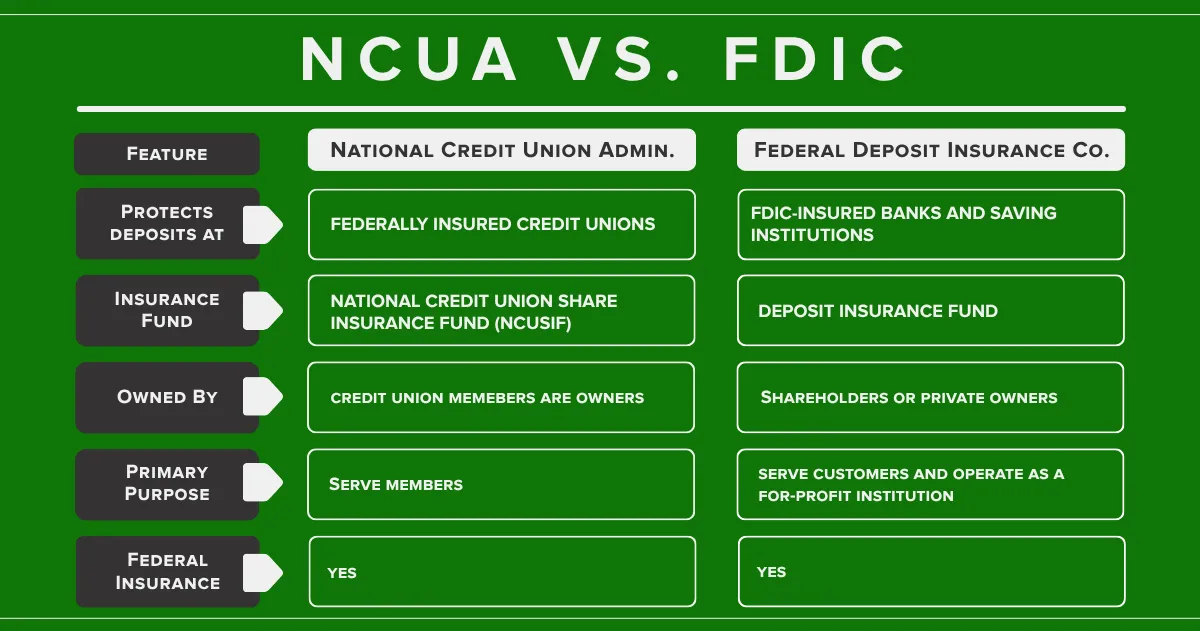
NCUA vs. FDIC: What’s the Difference?
For most account holders, the practical differences are smaller than many people expect.
FDIC
- Insures eligible deposits at participating banks
- Covers eligible deposit accounts up to applicable limits
- Oversees insured banking institutions
NCUA
- Insures eligible deposits at federally insured credit unions
- Covers eligible deposit accounts up to applicable limits
- Oversees federally insured credit unions
From a member perspective, both systems exist to help protect depositors and maintain confidence in the financial system. The bigger distinction often isn’t the insurance itself. It’s the business model.
Banks and Credit Unions Are Structured Differently
While both offer checking accounts, savings accounts, loans, and digital banking services, banks and credit unions operate differently.
Banks are generally owned by shareholders and operate as for-profit institutions.
Credit unions operate as member-owned financial cooperatives. Members are owners, and the institution exists to serve those members rather than outside shareholders.
This distinction often influences:
- Organizational priorities
- Fee structures
- Community involvement
- Member service philosophy
- Financial education efforts
It doesn’t make one inherently safer than the other, but it does help explain why many people are drawn to the credit union model.
What Types of Accounts Are Usually Covered?
Federal deposit insurance generally applies to traditional deposit accounts, such as:
- Checking accounts
- Savings accounts
- Money market deposit accounts
- Share savings accounts
- Share certificates or CDs
Coverage rules can vary based on account ownership categories and other factors.
If you have questions about specific account types or unique circumstances, it’s always a good idea to review current insurance guidance or speak with your financial institution directly.
What About Investment Accounts?
This area often causes confusion.
Investment and wealth-management products typically do not receive the same federal deposit insurance protection as traditional deposit accounts.
Examples may include:
- Stocks
- Bonds
- Mutual funds
- Exchange-traded funds (ETFs)
- Certain investment accounts
These products carry varying levels of investment risk and are generally treated differently than insured deposit accounts.
That’s why it’s important to understand the type of account you’re opening and ask questions if you’re unsure how a particular product is protected.
How Can You Tell If a Credit Union Is Federally Insured?
Most federally insured credit unions prominently disclose their insurance status.
You may see references to:
- NCUA
- Federally insured by NCUA
- National Credit Union Share Insurance Fund
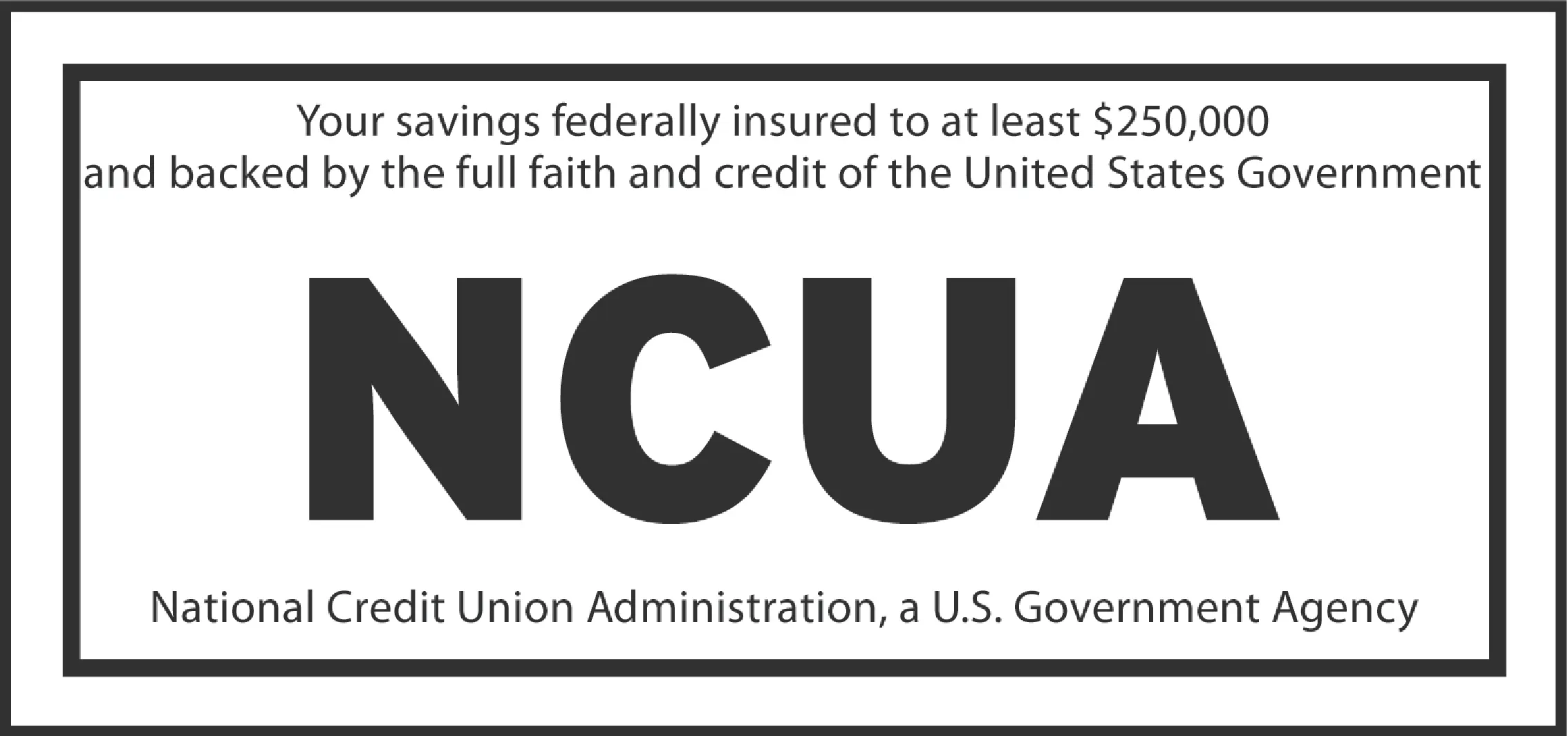
- Or, look for this logo:
If you’re unsure, ask before opening an account.
A reputable credit union should be able to clearly explain its insurance coverage and answer questions about deposit protection.
Why This Matters When Choosing a Financial Institution
When consumers compare banks and credit unions, safety is often one of the first concerns mentioned.
But many people quickly discover that the conversation expands beyond insurance.
Questions often become:
- Is the mobile app easy to use?
- Can I get help when I need it?
- Are there convenient branches and ATMs?
- Do they provide financial education?
- Will they help me reach my financial goals?
- Do I feel valued as a member or customer?
Insurance matters because it provides peace of mind. Once that foundation is established, many people begin evaluating the services, support, technology, and educational resources available through each institution.
Looking Beyond Deposit Insurance
As you compare financial institutions, it’s worth considering the full experience.
Many people find that choosing a financial institution is about more than rates and fees. They want convenient digital banking, reliable security, helpful resources, and a place they can turn to when questions come up. At ICCU, members have access to resources such as:
- Solid eBranch Mobile and Online Banking Tools
- Financial Wellness and Education Resources
- Next-Level Security and Protection Resources and Education
- Investment in the Communities Where We Live and Work
- And Much More
This is all on top of the typical personal and business accounts, loans, and services you expect from any financial institution.
So, Is Your Money Safe at a Credit Union?
For federally insured credit unions, the answer is yes. Eligible deposits receive federal insurance protection through the NCUA, just as eligible deposits at banks receive protection through the FDIC.
The choice between a bank and a credit union usually comes down to factors such as service, convenience, digital tools, financial education resources, lending options, and personal preference, rather than concerns about federal deposit insurance.
If you’re considering joining a credit union, don’t let misconceptions about safety hold you back. Instead, focus on understanding how the institution serves its members, what resources it offers, and whether it aligns with your financial goals.
After all, the best financial institution isn’t just the one that protects your money. It’s the one that helps you make the most of it.